
Buying guide4 min readBy Ozyrix
How to mark two keyhole slots for a heavy mirror
Measure between the narrow seats on two mirror keyhole slots. Transfer both screw centres level, then choose fixings suited to your UK wall and mirror.
Measure between the narrow seats of the keyhole slots, where the screw shanks will rest. The large round openings let the heads in; on a conventional keyhole plate they sit below the final support points. If your fittings differ, follow the mirror maker's diagram. Using the openings as your marks can put the mirror at the wrong height.
Check the mirror and the wall before buying fixings
Read the mirror maker's hanging instructions and check the weight of the whole mirror and frame. Use both slots if the maker specifies two. Check the required screw head shape, shank size and head clearance. The head must pass through the entry and be retained in the narrow seat. Measure the actual fitting or use the supplied template as instructed. Do not substitute D-rings, wire or adhesive strips unless the maker approves the alternative for that mirror.
The same marks can need different wall fixings
A Victorian lath-and-plaster wall needs its backing and condition assessed; do not assume the plaster or laths can carry a heavy mirror. On a 1930s solid brick wall, choose an anchor rated for the actual masonry. Modern dot-and-dab needs an appropriate system that can support the mirror across the void, not one that crushes the board against it. For timber or metal C-stud plasterboard, confirm the structure and choose a fixing designed for that assembly. Nominal 400 mm or 600 mm stud centres cannot tell you where to put the marks or how much the wall will carry.
If the mounting points do not line up with a suitable support, move the mirror or use a mounting system the mirror maker approves. If the wall, mounting system or load rating is uncertain, ask a qualified installer.
Transfer the two centres without moving the height
- Lay the mirror on a clean, padded surface as the maker directs. Measure from the top edge to the narrow seat of each slot and check the two offsets agree. Measure the seat-to-seat distance, centre to centre. If the fittings are intentionally offset, use the maker's template or instructions rather than forcing the marks level.
- Mark the intended top edge on the wall in pencil, then measure down by the seat offset. For example, a mirror top at 1,620 mm above the floor and seats 75 mm below the top give a fixing line at 1,545 mm. Use a bubble to level the line; a floor may slope.
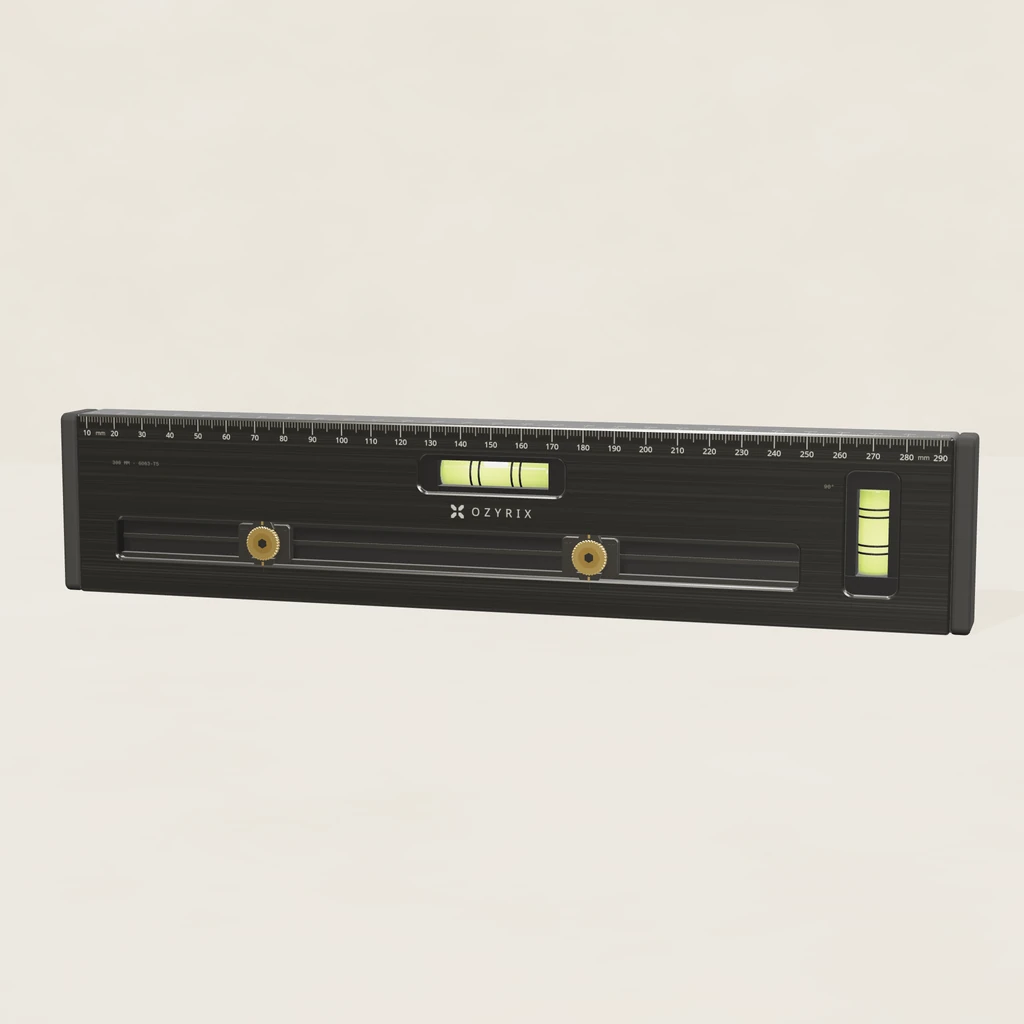
- For equal-height seats, set the two sliders to the measured separation, hold the level horizontally and transfer both points with your own pencil. If the centres are wider than the sliders can span, use a longer level or the supplied full-size template rather than guessing a second mark.
- Check the distance and alignment again. Before drilling either hole, check for concealed pipes and cables with a suitable detector. Check likely service routes on both sides where accessible. If you cannot establish that both points are suitable, stop and consult a qualified tradesperson.
When hanging the mirror, use a second person or a qualified fitter if the weight or size makes it awkward. With the mirror supported, check that both slots are fully seated on their screw shanks before letting go. If it rocks or either fitting fails to seat, take it down and investigate.
Pick a tool for the marks, not the load
The Anodised Aluminium Picture Level measures 300 × 60 × 20 mm and has horizontal and vertical vials and twin knurled brass sliders. The sliders position the points; you make the marks with your own pencil. Wall fixings and pencil are not included. Ordered on its own, the level is £23.98 total for standard Great Britain mainland delivery (£19.99 for the level and £3.99 delivery). See the delivery policy for where orders can be sent. Check the product page for availability or request a one-off stock email if it is unavailable. For arranging several light frames instead, see how to lay out a gallery wall in a rented flat.
Questions buyers ask
Do I measure between the round openings or the narrow seats?
Measure between the centres where the screw shanks will rest once the mirror is seated. Use the mirror maker's template if one is provided.
Can I use a 300 mm level if my mirror has wider fixing centres?
You can use it to check a short reference line. For transferring both points in one setup, use a longer level or a full-size template checked for level.
Can I use one fixing if only one slot lines up with a stud?
No, if the mirror was designed to hang from two. Choose a position or a manufacturer-approved mounting method that supports both points. Ask a qualified installer if you are unsure of the wall or load.