Buying guide4 min readBy Ozyrix
How to find studs in UK walls: plasterboard, dot-and-dab and brick
How to tell a stud wall from dot-and-dab or solid brick, find the studs behind UK plasterboard, and when a magnetic stud finder is the right tool.
Before you drill, work out what is behind the paint. British homes use three main kinds of wall, and each needs a different approach. Get this right and a shelf, mirror or frame goes up once, in the right place.
1. Work out which wall you have
Knock with a knuckle every 10 cm or so along the wall at chest height.
- Stud partition. Plasterboard screwed to timber or metal studs. It sounds hollow almost everywhere, and a little duller over each stud. Studs are usually set at 400 mm or 600 mm centres, so once you find one the next is easy to predict. This is common in internal walls, newer flats and loft conversions.
- Dot-and-dab. Plasterboard stuck straight onto brick or block with blobs of adhesive. It sounds hollow in patches and solid where each dab sits. There are no studs at all. You'll often find this on external walls and in houses built from the 1980s onwards.
- Solid plastered masonry. Wet plaster applied directly to brick or block. It sounds solid all over, which is typical of older terraces and party walls.
2. Finding studs behind plasterboard
Plasterboard is fixed to each stud with steel screws in a vertical line. Find the screws and you have found the stud.
Hold a magnetic stud finder flat against the wall and slide it slowly sideways. When it passes over a screw head, the magnet pulls towards the wall. Mark the spot lightly in pencil, then move up and down the wall: a second and third screw in a straight vertical line confirm the stud's centre. Measure 400 mm or 600 mm either side to find its neighbours, and check each with the magnet before you drill.
A magnet only responds to steel and iron. It won't read paint, skim or how dense the wall is, so it keeps working over uneven plaster. It also has nothing to calibrate and no battery to go flat in the drawer.
3. Dot-and-dab walls
On dot-and-dab, the magnet will find little or nothing, because there are no studs or rows of screws to find. That result is useful in itself: it tells you to fix into the brick or block behind the board, not into the board.
Use a fixing long enough to pass through the plasterboard and the gap behind it and still get a good bite into the masonry, or one made specifically for dot-and-dab walls. Don't overtighten, or you'll pull the board in towards the wall.
4. Before you drill: cables and pipes
UK wiring is meant to run in "safe zones": straight up, down or across from a socket or switch, and within 150 mm of the ceiling or a wall corner. Avoid drilling in those lines.
A magnetic stud finder does not detect copper pipes or electrical cables. If you're unsure what's in a wall, use a dedicated cable and pipe detector, or ask an electrician. Keep any strong magnet at least 15 cm away from pacemakers, implanted medical devices and bank cards.
5. Magnetic or electronic stud finder?
| Magnetic | Electronic | |
|---|---|---|
| Power | None | Battery |
| Finds | Steel screws and nails in the stud | Changes in density behind the board (some models also sense live cables) |
| Best on | Plasterboard on timber or metal studs | A wider mix of walls, when calibrated |
| Weak on | Dot-and-dab and solid walls (no fixings to find) | Uneven or thick plaster, which can give false readings |
For a UK flat or house where most of the job is hanging frames, shelves and mirrors on plasterboard, a magnet is the simpler tool. For walls you know nothing about, an electronic detector with cable sensing is a useful second check.
Our pick
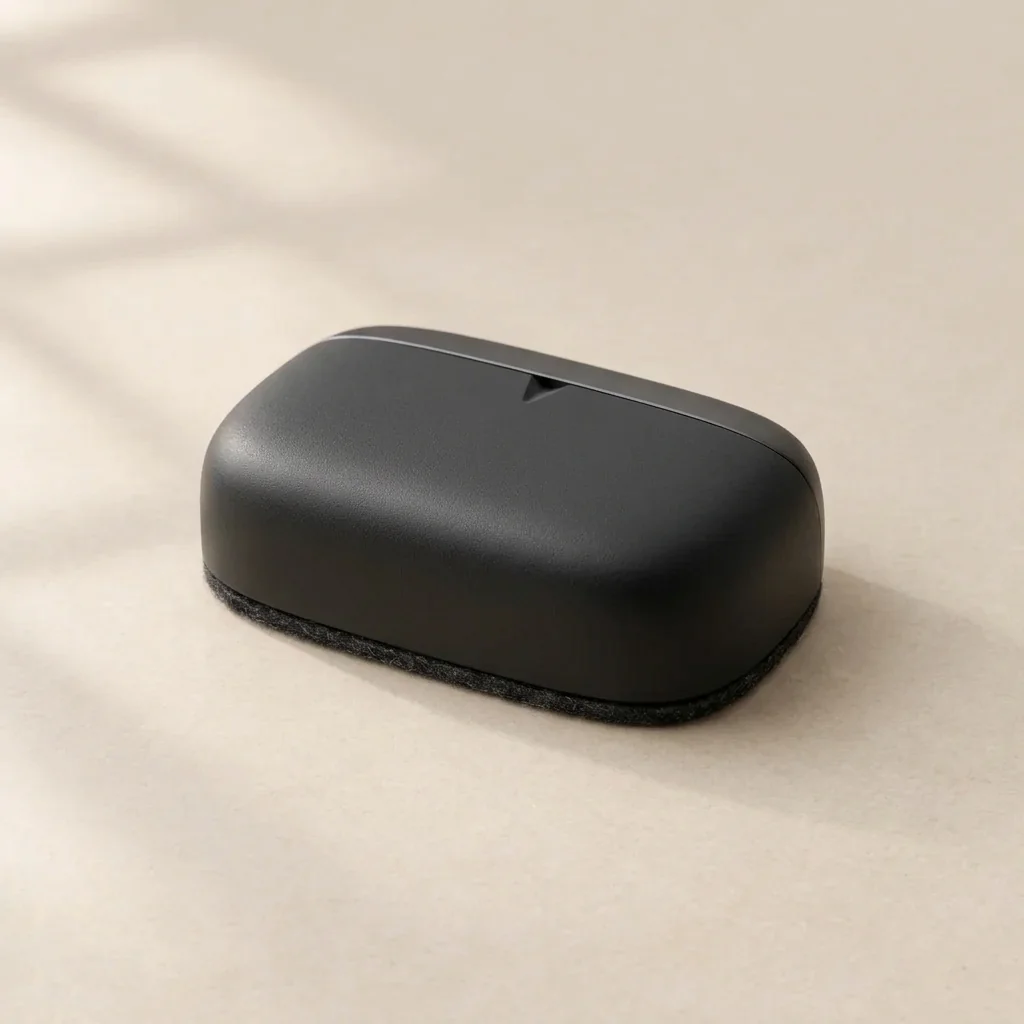
The Magnetic Stud Finder (£15.99) is battery-free, with a centre notch for marking and a soft felt base.
If you're hanging frames, the Wall Hanging Kit (£32.99) pairs it with the Press-to-Mark Alloy Picture Level. That's £2.99 less than buying both, and the kit qualifies for free GB mainland delivery. For tiling and awkward alcoves, the Wall & Tile Layout Kit (£30.49) pairs the stud finder with the 6-Arm Alloy Angle Template.
Neither kit is on sale yet. Leave your email on the product page and we'll write once, when you can order. For a renter-friendly walk-through, read how to hang a gallery wall in a rented UK flat.
Questions
- How far apart are studs in UK walls? Usually 400 mm or 600 mm between centres. Confirm each one before drilling.
- Will a magnetic stud finder find pipes or cables? No. It responds only to steel and iron fixings. Use a cable and pipe detector for those.
- Why can't I find any studs? You may have a dot-and-dab or solid wall. Fix into the masonry behind, using a fixing suited to that wall.
- Can I hang a heavy mirror on plasterboard? Fix into a stud where you can. Otherwise use a cavity fixing rated for the weight, and check the load rating on its packaging.