
Buying guide5 min readBy Ozyrix
Hallway coat hooks: height, spacing and solid-wall fixing in UK homes
Set hallway coat hooks at the right height for adults and children, space them for real coats and fix them to solid brick or block walls in UK homes.
Plan coat hooks around the people and the coats, not the wall. For adults, a common starting point is about 1,600–1,800 mm above the floor; for a lower row for children, about 1,000–1,200 mm. Space the hooks 120–160 mm apart for jackets and bags, and wider for bulky winter coats. Then check the hallway width, the wall and the services before you drill.
Set the height for the people using them
| Who or what | Suggested hook height | Spacing between hook centres |
|---|---|---|
| Adults, everyday jackets and bags | About 1,600–1,800 mm | 120–160 mm |
| Adults, long or bulky winter coats | High enough for the longest coat to clear the floor | About 180–220 mm, or stagger the heights |
| Children | About 1,000–1,200 mm, adjusted to reach without stretching | 120–160 mm |
| Dog leads, keys and small bags | Wherever they are easy to grab by the door | 120 mm is usually enough |
These are starting points, not rules. Two quick checks make them yours:
- Longest coat. Measure from the hanging loop to the hem of the longest coat. The hook needs to sit at least that high above the floor, plus a little clearance, so the hem does not drag or sit on a radiator.
- Shortest adult. The top of the hook should be easy to reach with a coat in one hand.
For two rows, offset the lower hooks so they sit between the upper ones. Otherwise coats on the top row hang over the children's hooks.
Check the hallway width
Many UK hallways, especially in Victorian and Edwardian terraces, are narrow. Hang your bulkiest coat on a hanger against the wall and measure how far it sticks out. Then check what is left:
- Clear width past the coats for people, pushchairs and bikes.
- The swing of the front door and any under-stairs or cupboard doors.
- Radiators, which you should not cover with coats.
- Light switches, the doorbell and any meter or consumer unit in the hall. Keep coats clear of them, and do not drill near them.
If space is tight, a single row of hooks behind the door swing or along the side of the stairs may work better than a long row opposite the door.
Identify the wall before choosing fixings
| Hallway wall | Typical home | What it means for hooks |
|---|---|---|
| Solid brick or block with plaster | External and party walls in many older homes | Use plugs suited to the masonry and follow the fixing maker's drill size and depth |
| Lath-and-plaster | Internal walls in many Victorian and Edwardian homes | Do not assume the laths or old plaster will hold; establish a sound backing or ask a qualified fitter |
| Stud plasterboard | Internal walls in many modern homes | Fix into a confirmed stud with a suitable method, or use hollow-wall anchors matched to the board |
| Dot-and-dab | Inside of external walls in many modern homes | Use a system designed to bridge the gap and grip the masonry behind |
If you are not sure which you have, start with how to find studs in UK walls. For more on fitting hooks to each wall, see how to hang wall hooks on UK plasterboard, dot-and-dab and brick.
Fixing hexagonal hooks to solid brick or block
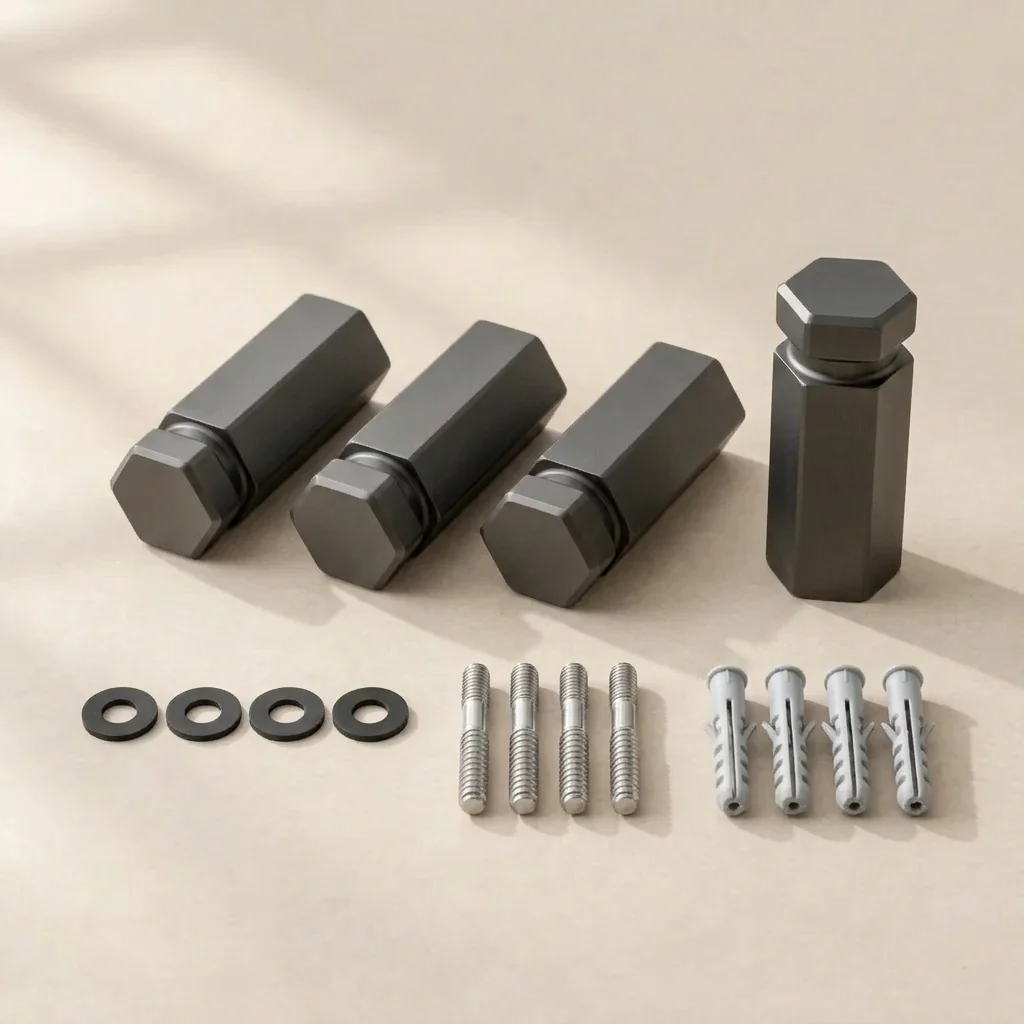
The Hexagonal Aluminium Wall Hooks (4-Pack) are machined from 6061-T6 aluminium with a bead-blasted matte charcoal anodised finish. Each hook is 19.0 mm across flats × 45.0 mm long (21.94 mm across vertices). A coat loop sits on a smooth Ø14.0 × 6.0 mm anti-slip neck, 8.0 mm behind the front face. The hook screws onto a concealed dual-thread M6 hanger bolt, which fits a flush M6 × 1.0 blind socket in its back.
The 12-piece UK fixing kit includes four M6 hanger bolts, four EPDM rear washers and four PA6 solid-wall plugs (Ø8 × 40 mm). A UK wall-fixing quick guide is also included. Hollow plasterboard anchors are not included. For hollow plasterboard, choose fixings rated for the board thickness and intended load. Check that the maker approves the fixing for a hook with a blind M6 × 1.0 socket.
On sound solid brick or block:
- Check for concealed pipes and cables with a suitable detector, and avoid likely routes above, below and beside switches.
- Mark the hook positions in pencil. Set the twin brass markers on the Anodised Aluminium Picture Level to your hook spacing, centre the bubble and mark two points at a time with your own pencil; work along the row from the first mark. The level does not include wall fixings or a pencil.
- Use the supplied plugs only where the quick guide says they suit your masonry. For hollow or lightweight block, use a fixing rated for that particular block. Follow its drill size and depth: M6 describes the thread, not the drill bit.
- Fit the hanger bolt and washer as the quick guide shows, then seat the hook evenly against its washer. If the hook turns when seated or the plug feels loose, take it off and check the fixing.
For more on the hanger bolt, see M6 hanger bolts or screws for a threaded wall hook.
Wet coats and full school bags are heavier than they look, and children sometimes swing on hooks. Use the lower of the hook and fixing ratings for your wall. Keep the small parts away from young children.
Ordered on their own, the hooks are £21.98 total for standard Great Britain mainland delivery (£17.99 for the pack and £3.99 delivery). Free GB mainland delivery applies to orders of £30 or more; see the delivery policy. Check the product page for current availability. If the item is not in stock, you can request a one-off stock email there.
Questions buyers ask
How high should coat hooks be in a UK hallway?
A common starting point is about 1,600–1,800 mm above the floor for adults, checked against your longest coat so the hem clears the floor and any radiator. For children, a lower row at about 1,000–1,200 mm works well.
How far apart should coat hooks be?
About 120–160 mm between hook centres suits jackets and bags. For bulky winter coats, leave around 180–220 mm or stagger the heights so the coats do not bunch together.
Can I fit these hooks to a plasterboard hallway wall?
Yes, if the fixing is rated for the board and load and its maker approves it for the hook’s blind M6 × 1.0 socket. Hollow plasterboard anchors are not included. The included plugs are for suitable solid walls.