
Buying guide6 min readBy Ozyrix
Keyhole slots vs D-rings vs sawtooth hangers: how to measure and level UK frames
Compare keyhole slots, D-rings and sawtooth hangers on frames and mirrors. Learn where to measure each one and how to mark level hanging points first time.
Turn the frame over before you buy fixings or pick up a tape. A sawtooth hanger hangs from one point; D-rings and keyhole slots usually hang from two. Two-point mounts hold a frame straighter, but only if both marks match the hardware exactly, measured where the frame will actually sit on its screw or hook.
Compare the three
| Sawtooth hanger | D-rings | Keyhole slots | |
|---|---|---|---|
| What it looks like | A toothed metal strip at the top centre | A pair of rings near each side, used on two hooks or with a wire between them | Plates or recesses with a round entry and a narrow seat |
| Hanging points | One | Two hooks, or a wire on one or two hooks | Usually two screws |
| Typical use | Small, light frames | Most framed prints and many mirrors | Mirrors and frames meant to sit close to the wall |
| Where to measure | Down to the tooth you will use | To the inside top of each ring, held upright as it will sit | To the narrow seat where the screw shank rests |
| Room for error | Fine-tune by moving to a neighbouring tooth | Two hooks stop the frame swinging; marks must match | Almost none; if the spacing is out, one screw will not seat |
| Common mistake | A single tooth off centre, so the frame hangs crooked | Measuring to the outer edge of a floppy ring | Measuring to the round openings |
Whichever hardware you have, follow the frame or mirror maker's hanging instructions and do not swap in different hardware unless they approve it.
Why tape measurements go wrong on two-point mounts
Level marks only work if the hanging points sit at the same height on the frame. Check the drop to both before transferring the marks. Most errors creep in before you reach the wall.
- The tape hook moves. The end hook slides slightly by design. For a precise spacing, measure from the 100 mm mark and subtract 100 mm.
- Guessing the centre of a ring. Measure from the same edge of each ring, for example the left inside edge of both. That gives the centre-to-centre spacing without guessing either centre.
- Loose rings. D-rings flop flat. Lift each one upright, as it will sit on its hook, before measuring.
- Reading at an angle. Look straight down at the tape blade, not from the side.
- Moving the tape at the wall. Re-measuring the spacing on the wall adds a second error to the first.
Keyhole slots are the least forgiving. The screw head must pass through the round entry and the shank must sit in the narrow seat. For a heavy mirror, see how to mark two keyhole slots for a heavy mirror.
Lock the spacing instead of re-measuring it
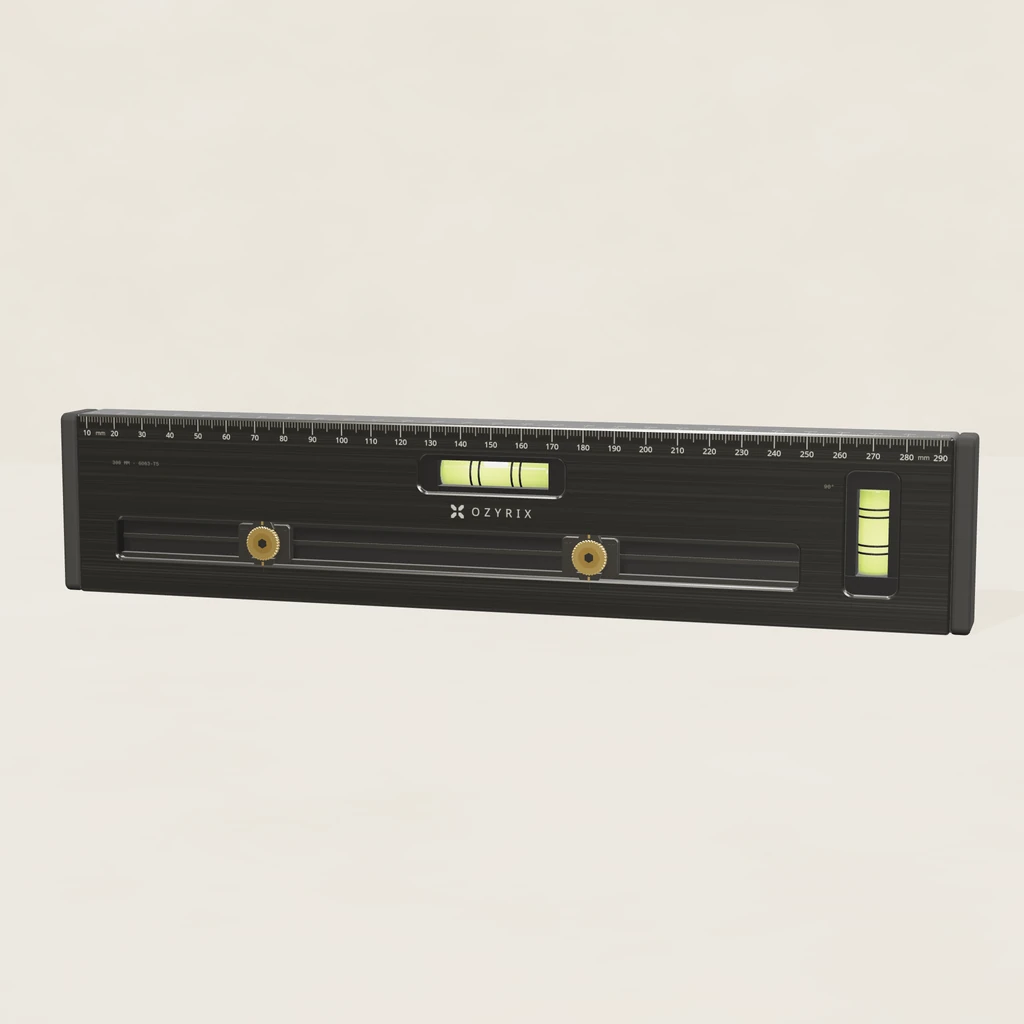
A picture level with sliding markers lets you take the spacing from the frame and carry it to the wall without reading a tape twice.
- Lift the D-rings upright or find the narrow keyhole seats.
- Lay the level across the back of the frame and slide one marker in line with each hanging point. Read the scale to confirm the spacing.
- Measure the drop: the distance from the top of the frame to each hanging point. Check both drops agree.
- At the wall, mark the hanging height. Hold the level with the markers at that height, centre the bubble and mark both positions with your own pencil.
- Check the spacing with a tape and the bubble again before drilling.
The markers are non-marring and the level makes no holes, so the only marks on the wall are your pencil marks. If the hanging points are further apart than the level's scale, use a longer level or a full-size paper template checked for level rather than guessing the second mark.
Wire and sawtooth hangers
For D-rings with a wire between them, pull the wire taut towards the top of the frame, as it will sit on the hook, and measure the drop to the peak. A single hook lets the frame swing off level. Two hooks spaced along the wire hold it better; measure the drop with the wire pulled up over two fingers spaced as the hooks will be.
For a sawtooth hanger, mark one point on the frame's centreline, at the frame's top edge height minus the drop to the tooth you will use. If the frame hangs slightly crooked, move it one tooth along rather than adding a second hole.
Before you drill
The marks are positions, not proof of a safe or strong fixing. Work out the wall type first: stud plasterboard, dot-and-dab and solid masonry need different fixings. If you are unsure, start with how to find studs in UK walls. Check for concealed pipes and cables with a suitable detector, and avoid likely service routes above, below and beside sockets and switches. Choose fixings suited to the wall and the weight, and use the lower of the frame hardware and fixing ratings. If you rent, ask your landlord before drilling.
The level for the job
The Anodised Aluminium Picture Level measures 300 × 60 × 20 mm. It has a 0–300 mm laser-etched metric scale on the top bevel, horizontal and vertical vials, and twin solid brass, knurled, non-marring sliding markers in a recessed front rail. The markers set the positions; you make the marks with your own pencil. Wall fixings and pencil are not included. Ordered on its own, the level is £23.98 total for standard Great Britain mainland delivery (£19.99 for the level and £3.99 delivery).
The Wall Hanging Kit adds the battery-free Magnetic Stud Finder, which locates ferrous screws and nails behind timber-stud or metal-stud plasterboard. It does not detect solid timber, live cables or water pipes. The kit is £32.99 with free GB mainland delivery. It contains the two tools and a printed Quick-Start card; wall fixings, screws and a pencil are not included. Keep the strong magnets away from pacemakers, other implanted medical devices, bank cards and electronics. See the delivery policy for where orders can be sent. Check the product page for current availability. If the item is not in stock, you can request a one-off stock email there. Hanging several frames? See hang a gallery wall in a rented UK flat.
Questions buyers ask
Are D-rings or keyhole slots better for a heavy mirror?
Use the hardware and instructions the mirror maker supplies. Keyhole slots let a mirror sit close to the wall but leave almost no room for error in the marks. D-rings on two hooks are more forgiving.
Should I measure D-rings centre to centre?
Yes, or measure from the same edge of each ring, which gives the same spacing and is easier to read. Lift each ring upright first, as it will sit on its hook.
Can I hang a frame with one sawtooth hanger on two hooks?
No. A single sawtooth strip is designed to hang from one point at its centre. Use two hooks only if the frame has two hangers and the maker intends it.